
- Institutional
-
Our Treatments


Trust Your Teeth to the Experts
Book Appointment - Dental Technologies
- Contact

Leave your details, we'll call you on WhatsApp.
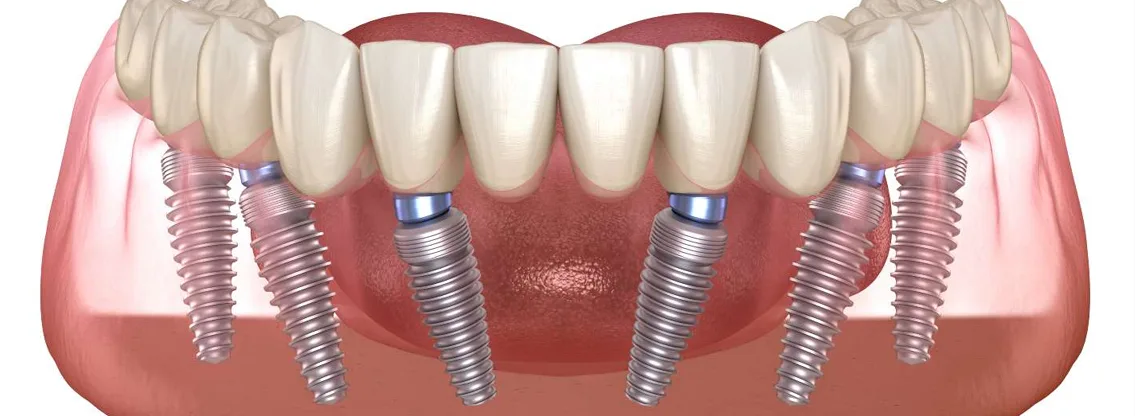
What Is an All-on-4 Dental Implant?
All-on-4 dental implants replace a full arch of missing teeth using just four implants to support a fixed bridge. Where a conventional full-arch restoration typically requires six to eight implants, this technique reduces that number to four — and in most cases allows the patient to leave the clinic the same day with fixed temporary teeth.
What makes the method distinctive is not the number of implants but the angle at which they are placed. The two front implants are positioned vertically, while the two rear implants are tilted at 30 to 45 degrees. This angulation avoids the maxillary sinus in the upper jaw and the inferior alveolar nerve in the lower jaw, and anchors the implants in the densest available bone. As a result, many patients who would otherwise need bone grafting or a sinus lift can avoid those additional surgeries entirely.
In practical terms, All-on-4 means replacing a removable denture — one that covers the palate, shifts while eating and requires adhesive — with a fixed set of teeth screwed to your jaw that only your dentist can remove.
Who Is a Good Candidate for All-on-4?
This treatment is not suitable for everyone. Patient selection is the single most important factor determining how long the result lasts.
Suitable candidates
- Complete tooth loss in the upper or lower jaw.
- Terminal dentition: remaining teeth are severely mobile and extraction is unavoidable.
- Dissatisfaction with removable dentures: slipping, gag reflex, reduced taste, difficulty speaking.
- Moderate bone loss with sufficient bone volume preserved in the anterior region.
- General health compatible with surgery.
Situations requiring caution
- Uncontrolled diabetes: impairs wound healing and integration of the implant with bone. Treatment can be planned once blood glucose is stable.
- Heavy smoking: significantly increases the risk of implant failure. Stopping or reducing before and after surgery is expected.
- Severe bone resorption: if insufficient bone remains even anteriorly, alternatives such as zygomatic implants are considered.
- Bruxism (clenching and grinding): not a contraindication, but a night guard and careful material selection must be part of the plan.
- Bisphosphonate medication: any drug affecting bone metabolism must be disclosed to your dentist.
- Untreated gum disease: periodontal treatment must be completed first.
Suitability cannot be determined by clinical examination alone. A three-dimensional CT scan measures bone density, volume and the position of anatomical structures. A "yes, you're suitable" given without that scan is not a reliable answer.
The All-on-4 Procedure Step by Step
1. Examination and digital planning
The first stage includes an intraoral examination, a panoramic X-ray and a cone beam computed tomography (CBCT) scan. Implant angle, depth and length are determined on the scan using planning software. Digital planning makes the surgery predictable and shortens operating time.
2. Pre-surgical preparation
If teeth remain, an extraction plan is made. Blood work is requested and current medication reviewed. Depending on your anxiety level and preference, local anaesthesia, sedation or general anaesthesia is discussed.
3. Surgery
Extractions and implant placement are usually performed in the same session. A single arch takes on average two to three hours. Four implants are placed at the planned angles, followed by the multi-unit abutments that will support the temporary bridge.
4. Fixed temporary bridge
If primary stability is sufficient, the fixed temporary bridge is fitted within 24 to 72 hours. It restores appearance and speech immediately, but it is not designed for hard foods. A soft diet is required throughout healing.
5. Healing (osseointegration)
Biological fusion of the implant with bone takes three to six months. Oral hygiene and follow-up appointments are critical during this period. The lower jaw generally heals faster than the upper.
6. Permanent bridge
Once healing is complete, impressions are taken and the permanent bridge is produced. Shade, form and bite are refined at this stage. Digital smile design allows the final appearance to be evaluated on screen before manufacturing begins.
How Long Does It Take? A Realistic Timeline
Duration depends on the extent of tooth loss and bone quality. For patients travelling from abroad, a typical plan looks like this:
- Day 1: examination, CT scan, planning.
- Day 2: extractions and implant surgery.
- Days 3–4: fitting of the fixed temporary bridge, bite check.
- Days 5–7: suture check, hygiene instruction, departure.
- After 3–6 months: second visit for the permanent bridge (5–7 days).
In total: two visits and roughly 10 to 14 days of clinic time. For patients planning dental treatment in Turkey, this timeline forms the basis for arranging flights and accommodation.
All-on-4 vs All-on-6 vs Conventional Implants
Which approach suits you depends on bone volume, bite forces and expectations.
- All-on-4: four implants per arch. Eliminates the need for grafting in most cases; shorter treatment time and lower cost. Preferred in patients with moderate bone loss.
- All-on-6: six implants per arch. Force is distributed across a wider area, which can be preferable in the upper jaw and in patients with strong chewing forces. Requires adequate bone volume. See our All-on-4 / All-on-6 implant page for details.
- Conventional implants: a separate implant for each missing tooth. The most natural solution, but more implants, longer treatment and generally higher cost. For a single missing tooth, a dental implant remains the first choice.
- Removable complete denture: lowest cost, lowest comfort. Bone resorption continues over time because the jaw receives no functional stimulation.
This is where the key difference emerges: an implant stimulates the jawbone functionally and slows bone resorption. With a removable denture, bone loss continues year after year and produces a collapsed appearance in the lower third of the face.
Prosthetic Materials
There are two main options for the permanent bridge, and the choice affects both aesthetics and durability.
- Acrylic on a titanium bar: acrylic teeth on a titanium framework. Lighter, easier to repair, lower in cost. Acrylic can discolour and wear over time.
- Monolithic zirconia bridge: milled from a single block of zirconia. Stain-resistant, highly wear-resistant, closest to the appearance of natural teeth. Higher cost and difficult to repair if fractured. Detailed information is available on our monolithic zirconia page.
In patients with bruxism, material choice alone is not enough; wearing a night guard directly affects how long the bridge lasts.
From Removable Dentures to All-on-4: What Changes Day to Day
For most people the decision is driven less by technical detail than by everyday experience. These are the differences long-term denture wearers most often report:
Eating
A removable denture delivers roughly a quarter of the chewing force of natural teeth. Biting into an apple, eating crusty bread or cutting a steak is out of reach for most wearers. With an All-on-4 bridge, force is transferred directly to the jawbone through the implants, so chewing power is far closer to natural. This is not only a comfort issue — returning firm vegetables and protein to the diet has a real effect on nutrition.
Taste and speech
An upper complete denture covers the palate, which carries a significant part of taste perception; when it is covered, food tastes different. An All-on-4 bridge can leave the palate open, preserving taste. The same open design makes sounds such as "s" and "sh" easier to pronounce, largely eliminating the lisp denture wearers commonly complain about.
Confidence and social life
The possibility of a denture shifting while laughing or speaking loudly creates a constant low-level tension. With a fixed bridge that anxiety disappears, along with adhesives and the routine of removing and storing the denture overnight.
Preserving facial structure
An edentulous jaw resorbs at a measurable rate each year. That loss reduces lip support, shortens the distance between chin and nose and produces an aged appearance. Because implants stimulate the jawbone through chewing forces, they slow this process. The aesthetic result comes not only from the teeth themselves but from the support given to the lower face.
Recovery Week by Week
Realistic expectations make recovery far easier. The timeline below describes a typical course; individual variation is normal.
First 72 hours
Swelling and bruising peak during this period and are entirely normal. Cold compresses, resting with the head elevated and taking prescribed medication on schedule are recommended. Smoking and alcohol should be avoided completely. Diet is limited to soft, lukewarm food.
Week 1
Swelling reduces noticeably. Sutures are checked and removed if required. The bite on the temporary bridge is reviewed. Oral hygiene at this stage should be gentle but consistent, using mouthwash as instructed.
Weeks 2–6
The gums begin to take their final shape and speech adapts. Diet moves gradually from soft to medium consistency. The most common mistake here is a patient who feels well returning to hard foods too early and fracturing the temporary bridge.
Months 3–6
Osseointegration completes during this phase. Outwardly nothing appears to be happening, yet this is the process that determines the longevity of the treatment. Follow-up appointments should not be skipped.
After the permanent bridge
The first few weeks are an adaptation period. Minor bite adjustments may be needed; this is normal and does not indicate failure.
Why Treatments Fail — and How to Prevent It
All-on-4 has a high success rate, and most causes of failure are both predictable and preventable.
- Inadequate planning: planning from a panoramic X-ray alone, without CT, cannot reliably determine implant angle and depth. This is the most common and most avoidable error.
- Forcing patient selection: applying All-on-4 to a patient with insufficient bone may look fine short-term but leads to implant loss later.
- Premature loading: fitting a temporary bridge before primary stability is adequate disrupts osseointegration.
- Poor hygiene: peri-implantitis is the leading cause of long-term loss and depends entirely on maintenance discipline.
- Unmanaged bruxism: without a night guard, excessive force fatigues both bridge and implants.
- Missing follow-ups: a loose screw caught early is a simple fix; left alone it becomes a fractured bridge and an overloaded implant.
How to Choose a Clinic
For patients travelling from abroad, clinic selection matters as much as the treatment itself. Ask these questions:
- Is 3D CT performed in-house? If planning is not based on a CT scan, the treatment is not predictable.
- Which implant brand is used, and what is the warranty? The brand should be provided in writing; components may need replacing years later.
- Is the treatment plan written? Which procedures are included in the price and how many visits are needed should be explicit.
- Is the permanent bridge material specified? The difference between acrylic and zirconia affects both cost and outcome.
- How are complications handled? Particularly important for a patient who lives far away.
- How experienced is the clinician in full-arch work? All-on-4 requires planning and prosthetic skills beyond standard implant surgery.
You can review our clinicians and facilities on our medical staff page, and our international patient page explains how we support patients travelling from overseas.
Common Misconceptions About All-on-4
"Four implants aren't enough — you always need more"
Implant number alone does not determine success; what matters is how force is distributed. Tilting the posterior implants makes the support area adequate with four. That said, it is not right for every patient — the decision follows the CT scan.
"The whole treatment finishes in a day"
The bridge fitted on the day is temporary. The permanent bridge is made after the implants have integrated with bone. Not knowing this in advance creates unnecessary disappointment.
"Implants are painful"
Surgery is performed under anaesthesia and no pain is felt during the procedure. Post-operative sensitivity is comparable to that after a tooth extraction.
"The body rejects implants"
Titanium is biocompatible and is not rejected by the immune system as foreign tissue. Failure is usually caused by infection or overloading; allergic rejection is extremely rare.
"The bridge will never need attention again"
Implants are long-lasting, but the bridge is a component that wears. Regular check-ups and eventual replacement are normal.
Anaesthesia and Sedation Options
Fear of dental treatment is the most common reason patients postpone care for years. All-on-4 surgery can be performed at three levels of comfort, chosen together according to anxiety level and general health.
- Local anaesthesia: the most frequently chosen option. The patient is awake and feels no pain, and returns to daily life quickly.
- Conscious sedation: medication delivered intravenously relaxes the patient. Consciousness is not fully lost, but most of the procedure is not remembered. Suitable for those with significant dental anxiety.
- General anaesthesia: the patient is fully asleep, with an anaesthetist present and appropriate equipment. May be preferred for long cases covering both arches.
Whichever method is chosen, blood values and current medication are reviewed beforehand. Heart conditions, blood thinners or uncontrolled blood pressure are not barriers to treatment — but planning must account for them.
Long-Term Care: Protecting Your Bridge
What determines the lifespan of an All-on-4 restoration is maintenance, not surgery. The bridge is fixed and cannot be removed by the patient, so cleaning differs from a removable denture.
Daily care
- Interdental brushes: the most important tool for cleaning the space between bridge and gum. Use at least once daily.
- Water flosser: removes debris from areas a brush cannot reach. Particularly recommended for All-on-4 patients.
- Superfloss: passed underneath the bridge to clean around the framework.
- Soft toothbrush: twice daily for the bridge surface and gum margin.
Clinical check-ups
Every three months in the first year, then at least twice a year. At these appointments the bridge is removed, the area beneath it professionally cleaned, screw torques checked and the bite adjusted if needed. A loose screw detected early takes minutes to correct; ignored, it leads to a fractured bridge and overloaded implants.
Peri-implantitis
Inflammation of the tissue around the implant is the leading cause of long-term implant loss. Early signs are redness, bleeding when brushing and persistent bad breath. Treated at that stage it is reversible; left to progress, surrounding bone is lost. Regular check-ups largely prevent this picture from developing.
What Determines the Cost
The price of All-on-4 treatment cannot be expressed as a single figure. Several variables affect it directly:
- One arch or both: treating both jaws together is priced differently from separate planning.
- Implant brand: brands with long-term clinical data cost more but offer continuity of components and warranty.
- Permanent bridge material: there is a clear difference between acrylic-titanium and monolithic zirconia.
- Additional surgery: the number of extractions and whether grafting or sinus work is required.
- Anaesthesia preference: general anaesthesia adds cost.
- Temporary bridge: whether same-day fixed teeth are provided. See our same-day implant page.
Requesting a written, itemised treatment plan both clarifies expectations and makes any additional charges visible from the outset. For a personalised plan and detailed information, please contact us or visit one of our polyclinics.
Frequently Asked Questions
Do I really get teeth the same day?
In most cases yes — but the teeth fitted are a fixed temporary bridge. The permanent bridge follows three to six months later, once the implants have integrated.
Does the procedure hurt?
No pain is felt during surgery thanks to anaesthesia. Afterwards, swelling and mild discomfort for a few days are normal and controlled with prescribed medication.
What if I don't have enough bone?
Angled placement of the posterior implants makes All-on-4 possible for many patients who would otherwise need grafting. Where bone is severely deficient, grafting or alternative techniques are evaluated.
I smoke — can I still have the treatment?
Smoking measurably increases the risk of implant failure. Treatment is possible, but stopping or substantially reducing before and after surgery is expected.
How long does it last?
With good hygiene and regular check-ups, implants can serve for decades. The bridge itself is a wearing component and may need renewal over time.
Is there an age limit?
There is no upper limit; general health matters more than age. The lower limit is completion of jaw growth.
How should I eat afterwards?
Soft foods for the first weeks, moving gradually to a normal diet. Very hard foods such as nuts and ice should be avoided permanently.
Can I have both jaws treated at once?
Yes. Treating both arches in one session is common, though it lengthens the procedure and may make sedation or general anaesthesia preferable.
Will the bridge look natural?
Shade, form and gum line are planned individually. Digital smile design allows the result to be reviewed before production.
Summary
All-on-4 offers people who have lost all their teeth, or are about to, a route back to fixed teeth without extensive bone surgery and with a considerably shorter timeline than conventional full-arch implant treatment. Its advantages — same-day fixed teeth, no palatal coverage, chewing force close to natural, and slower bone resorption — are real, but they depend on correct patient selection, CT-based planning and disciplined long-term maintenance.
The right decision cannot be made from an article. It is made after a clinical examination and a three-dimensional scan, with the alternatives explained. To have your own situation assessed, get in touch with us.
Dentbul Clinics

Trust Your Teeth to the Experts
Ücretsiz Muayene Al
The capital of your future is your happy smile - Dentbul
Institutional
Our treatments
Dental Technologies
Contact
Authorization
© 2026 | All rights reserved. Designed by Bkmsoft




Hello, to learn about treatment prices, see before and after images, and win a gift from Turkey's largest clinic, take the 20-second test below. 🙂
Which step would you like to proceed with?

See Prices

Ask What You Wonder
